

How to Read Bearing Part Numbers: A 2026 Guide
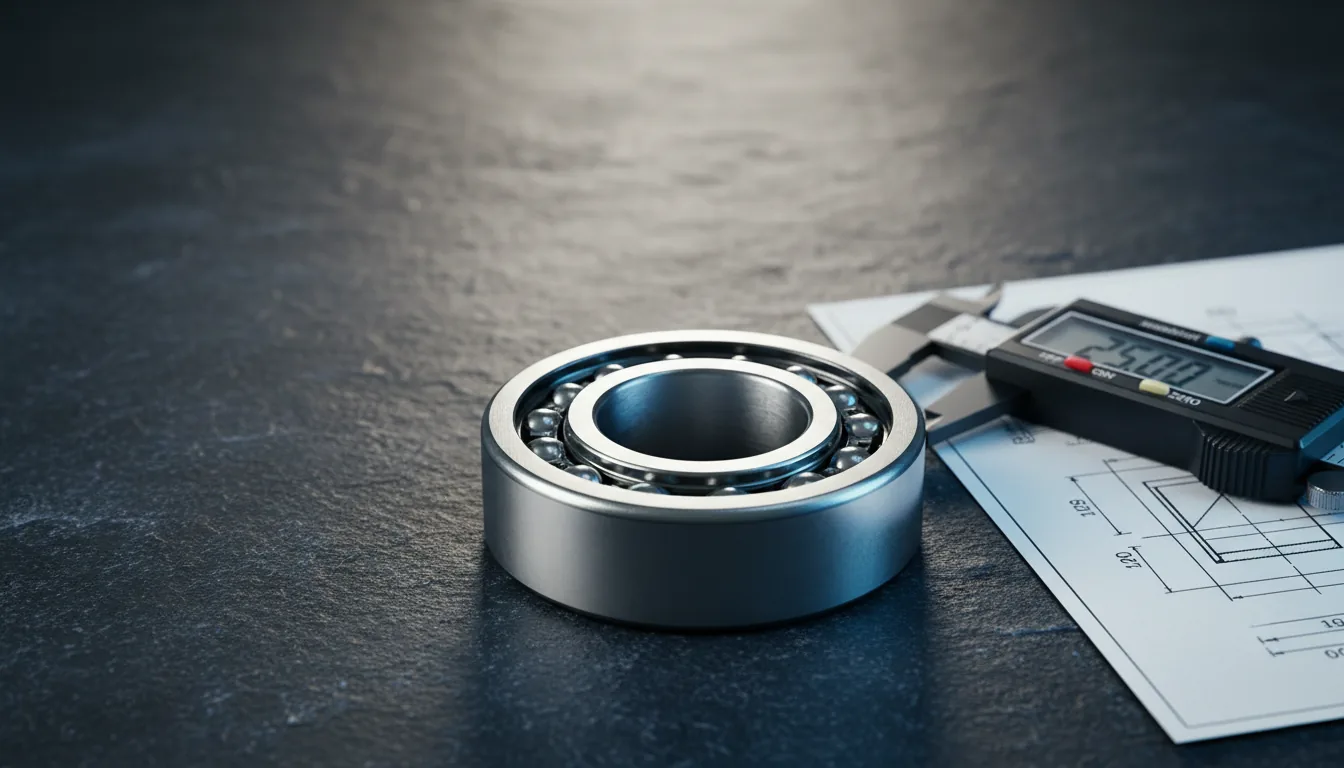
A standard industrial bearing part number consists of three main sections - the prefix, the basic series number, and the suffix detailing components like seals or clearance. Decoding these numbers correctly is essential for technicians and procurement staff across Indonesia to avoid ordering the wrong part, which leads to unnecessary downtime and wasted budget. By understanding the standard nomenclature, you can confidently identify exact replacement sizes from the HI-TEC ASIA catalog of over 2,000 industrial bearings.
This guide breaks down the standard bearing numbering system, explains how to calculate exact bore sizes, and decodes common suffixes like 2RS and ZZ so you can secure the right high-quality bearing for your machinery.
How do you read industrial bearing part numbers and calculate bore size?
A standard industrial bearing part number consists of three main sections - the prefix, the basic series number, and the suffix detailing components like seals or clearance. For standard bearings with a bore code of 04 or higher, multiply the last two digits by 5 to find the exact bore size in millimeters - meaning a 6205 bearing has a 25mm bore[1][2].
The basic designation is typically three to five digits long and follows a globally standardized ISO system[3]. Here is how to break it down step-by-step:
- Identify the bearing type (First digit): The first number indicates the bearing family. For example, a "6" denotes a single-row deep groove ball bearing, which is the most widely used type for radial loads[4][5].
- Determine the dimension series (Second digit): This digit defines the bearing's width and outer diameter relative to its bore. A "2" indicates the light dimension series, while a "3" represents a medium or heavy series[6][3].
- Calculate the bore size (Last two digits): The final two digits form the bore code. For bore codes between 00 and 03, the sizes are fixed at 10mm, 12mm, 15mm, and 17mm respectively[7][8]. For bore codes of 04 to 96, simply multiply the code by 5[9][10].
Using this rule, a standard 6205 bearing breaks down to a type 6 (deep groove), series 2 (light), and bore code 05. Multiplying 05 by 5 confirms a 25mm inner diameter[1][6]. Under ISO boundary dimensions, any standard 6205 bearing will measure exactly 25 x 52 x 15 mm[4][11]. Understanding this formula lets you verify measurements before browsing our industrial bearings catalog.
What do the 2RS, ZZ, and C3 suffixes mean on a bearing?
Common bearing suffixes include 2RS for two rubber seals, ZZ for two metal shields, and C3 for internal radial clearance designed for thermal expansion[12][13]. Accurately decoding these part numbers allows buyers to confidently identify exact replacement sizes from the HI-TEC ASIA catalog of over 2,000 industrial bearings.
While the basic number dictates the physical dimensions, the suffix tells you about the bearing's internal design. Choosing the wrong suffix can result in premature bearing failure - for instance, using a shielded bearing in a highly contaminated environment. Whether you are ordering our reliable HI-TEC value line or our premium HI-TEC SILVER range, checking the suffix ensures your machinery operates quietly.
Here is a breakdown of the most common suffixes:
| Suffix | Meaning | Application & Benefit |
|---|---|---|
| 2RS | Two rubber contact seals | Keeps grease in and heavy dust out. Ideal for highly contaminated environments[12][13]. |
| ZZ / 2Z | Two metal shields | Protects against larger debris while allowing higher rotational speeds than rubber seals[1][12]. |
| C3 | Greater than normal internal clearance | Accommodates thermal expansion. Standard for high-speed electric motors[7][13]. |
| NR | Snap ring groove and snap ring | Allows the bearing to be easily located and secured axially within a housing[13][14]. |
| M | Machined brass cage | Provides high strength and durability for heavy-duty or high-vibration applications[12][15]. |
By matching the correct suffix to your operating conditions, you protect your equipment from the false economy of cheap bearings that fail early. If you need help identifying the right suffix for your specific deep groove ball bearings, our team is ready to assist. Contact us today to find the perfect reliable fit.
Frequently Asked Questions
How do you read industrial bearing part numbers?
You read a bearing part number by breaking it into three sections: the prefix (material or special features), the basic number (bearing type, dimension series, and bore code), and the suffix (seals, shields, or clearance)[1][3]. The first digit of the basic number identifies the bearing type, such as a 6 for deep groove ball bearings[4].
What do the 2RS and ZZ suffixes mean on a bearing?
The 2RS suffix indicates that the bearing has two rubber contact seals, providing excellent protection against dust and moisture[12][13]. The ZZ suffix means the bearing is fitted with two metal shields, offering protection against debris while supporting higher rotational speeds than sealed variants[1][12].
How do you calculate the bore size of a bearing?
To calculate the bore size for standard bearings with a bore code of 04 or higher, multiply the last two digits of the basic number by 5[9][10]. For example, a bore code of 08 means the bearing has a 40mm inner diameter[16][17]. Codes 00, 01, 02, and 03 correspond to fixed sizes of 10mm, 12mm, 15mm, and 17mm[7][8].
What are the dimensions of a 6205 bearing?
A standard 6205 bearing has an inner diameter (bore) of 25mm, an outer diameter of 52mm, and a width of 15mm[4][11]. These standardized ISO boundary dimensions ensure that the physical fit remains consistent across all industrial machinery[6].
References
- Basic bearing designation system. https://www.skf.com/us/products/rolling-bearings/principles-of-rolling-bearing-selection/general-bearing-knowledge/bearing-basics/basic-bearing-designation-system (2026-07-21)
- Bearing numbers - meaning and identification. https://www.bearing.hu/news/how-to-read-bearing-numbers-and-what-to-do-when-the-marking-is-no-longer-visible/ (2025-11-21)
- Bearing designation. https://wiki.opensourceecology.org/wiki/Bearing_designation (2022-01-01)
- What Are the 6205 Bearing Dimensions — and How Do You Select .... https://www.ktbearing.com/news/industry-news/what-are-the-6205-bearing-dimensions-and-how-do-you.html (2026-05-13)
- Understanding Bearing Numbers: A Breakdown of 6205 ZZ .... https://www.linkedin.com/posts/farhan-alee-8642032ba_bearing-number-meaning-activity-7351882261908049920-RSt5 (2025-07-18)
- Deep groove ball bearing dimensions (6000, 6200, 6300 series, ISO 15). https://cballast.com/pdfs/guides/deep-groove-ball-bearing-dimensions.pdf (2026-07-09)
- How to Read a Bearing Number — BearingBrain. https://bearingbrain.com/guides/how-to-read-bearing-numbers (2026-07-20)
- Bearing Part Number Decoder. https://www.toolgrit.com/tools/bearing-decoder (2026-07-24)
- BEARING DESIGNATION SYSTEMS. https://www.nsk.com/content/dam/nsk-marketing/projects-completed/literature/service/bearing-designation-systems_bochure/en_bearing-designation-systems_bochure/preview-pdf_bearing-designation-systems_bochure_en/EN_Bearing_Designation_Systems_BD_03_2024_low-res.pdf (2026-07-21)
- Bearing dimensions and designations. https://www.nsk.com/content/dam/nsk/eu/en_gb/documents/bearings-europe/P_TI-0111_EN.pdf (2026-07-21)
- Deep Groove 6205 Ball Bearings 25mm X 52mm X 15mm. https://us.misumi-ec.com/blog/ball-bearings/deep-groove/6205-ball-bearings-25x52x15mm-z-zz-2rs/ (2019-02-22)
- How to Read a Bearing Number: Complete Guide (6000, 6200 .... https://blogs.lntbearings.com/how-to-read-a-bearing-number-complete-guide-6000-6200-6300-series/ (2026-03-26)
- Basic Designation System of Rolling Bearings | Dimension .... https://www.youtube.com/watch?v=3VR9k516kE8 (2025-09-08)
- Bearing Number Codes [Part 1]. https://www.youtube.com/watch?v=ZIfS9Xx5has (2023-09-14)
- Designation system. https://www.skf.com/group/products/rolling-bearings/ball-bearings/deep-groove-ball-bearings/designation-system (2026-08-01)
- NUMBERING SYSTEM QUICK REFERENCE GUIDE. https://ntn.ca/wp-content/uploads/2019/10/BearingQuickReferenceGuide-EN-Web.pdf (2025-11-03)
- Understanding Common Ball Bearing Number Designations. https://blog.pgnbearings.com/understanding-common-ball-bearing-number-designations/ (2023-06-01)